
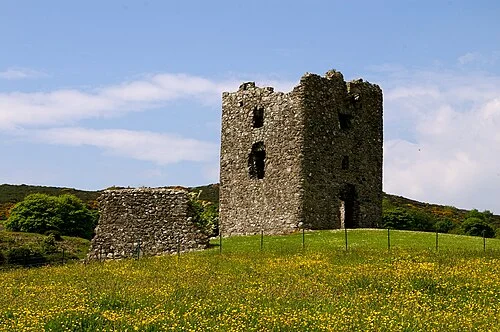
Photo: Liam Hughes from Milwaukee, WI, USA · CC BY 2.0. Resized and converted for the web. Full credit.

Moyry Castle stands above a strategic passage through the hills near the Armagh–Louth boundary. The ruined tower was built in 1601 for Mountjoy’s forces after the struggle to control the pass. It makes most sense as a place from which to read the landscape, rather than a furnished castle experience with rooms and displays.
Look at the position first
Before concentrating on the walls, notice the route through the surrounding high ground. The choice of site explains the tower’s military purpose. Modern roads and railway have changed how people move, but the constrained passage remains easier to understand from the castle than from a name on a map.
Read the surviving shell
Rounded corners and gun loops belong to a defensive building, not a country-house façade. Look for the evidence that is visible without climbing the masonry or entering an unsafe space. An exterior visit can explain the structure’s purpose even when an internal area is inaccessible or the ground is wet.
Keep the neighbouring sites in sequence
Kilnasaggart’s early Christian stone offers a much earlier story in the same wider corridor. Seeing both is a useful pairing if access and time permit. Avoid presenting them as parts of one complex: each has its own history, approach and conservation needs.
Before you go
Check current monument access and follow on-site notices. Expect an exposed rural setting, uneven ground and limited facilities. Stay away from railway property and do not improvise a route across neighbouring fields. The tower is a ruin; there is no promise of stair access, a staffed reception or a sheltered indoor alternative in poor weather.
Plan your visit
DAERA — Moyry Castle and Ring of Gullion heritage · Department for Communities — historic places
More in Armagh
Slieve Gullion Forest Park: a woodland day below the summit · Explore the county guide
Have a story to share?
Tell us about a place, a journey or a different side of Ireland. Send your article to the Ramble editorial team for review.