
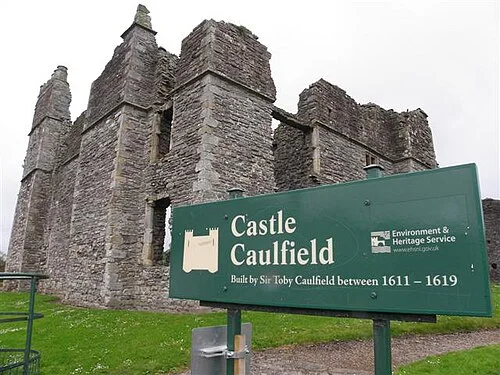
Castle Caulfield exterior and interpretation board. Photo: Kenneth Allen · CC BY-SA 2.0. Resized and converted for the web. Full credit.

Castle Caulfield’s substantial ruin is a reminder that the word castle can describe a very different kind of building from a medieval fortress. In Castlecaulfield village, near Dungannon, its tall walls and surviving details belong to a seventeenth-century house. Look for the domestic clues as well as the imposing outline.
Begin with the visible shape
The heritage authority dates Sir Toby Caulfield’s house to 1619. What remains is incomplete, so the gaps are part of understanding it. Compare the surviving wings and look at the windows and chimney stacks from the visitor areas. Those features suggest a house organised for living as well as displaying status.
Look closely at the gatehouse
The family arms above the gatehouse provide a detail to seek out without needing to enter inaccessible spaces. Read the interpretation before assigning a purpose to every opening. A ruin can be rewarding from ground level; you do not need to climb masonry to understand its scale.
Allow the history to be complicated
The building was burned in 1641 and subsequently repaired and occupied. Its story therefore continues beyond one dramatic event. A careful visit leaves room for changes of use, damage and repair, rather than reducing everything visible to a single year or assuming all the stonework survived in its first form.
Before you go
Check current Department for Communities access notices before travelling. Entry is listed as free, with restrictions possible during works. Keep within the permitted visitor areas and leave unstable walls alone. Plan this as a compact village heritage stop, and check separate opening arrangements if you want to add another nearby attraction or a meal.
Plan your visit
Department for Communities — Castle Caulfield · Visit Mid Ulster — historic places
More in Tyrone
Harry Avery’s Castle: two towers above the valley · Explore the county guide
Have a story to share?
Tell us about a place, a journey or a different side of Ireland. Send your article to the Ramble editorial team for review.