
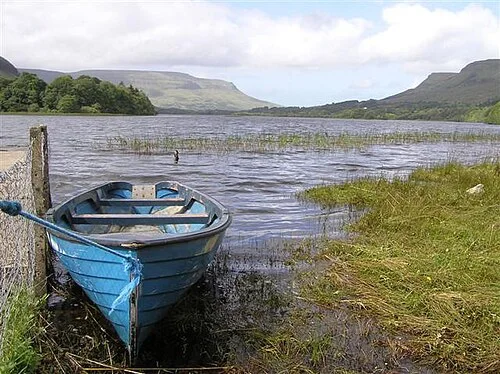
Photo: Kenneth Allen · CC BY-SA 2.0. Resized and converted for the web. Full credit.

Glenade is a landscape to look at slowly. The lake sits between steep-sided country, with the Dartry range forming part of the wider setting. From the public viewing area, you can begin to understand the valley without planning a difficult climb or assuming that an attractive line on the hillside must be a walking route.
Begin at the viewing area
Leitrim Tourism identifies a parking and viewing area at the southern end of the lake. Use a proper stopping place rather than pulling onto a narrow verge for a photograph. Give yourself a moment to look along the valley and notice the relationship between water, fields and higher ground. The view is more interesting when it becomes a landscape rather than a backdrop.
Enjoy the legend as a legend
The Dobhar Chú, or water-dog story, is associated with Glenade. It is part of the area’s folklore, not evidence of an animal a visitor should expect to see. A carving connected with the story can be found in the nearby Conwell graveyard. If visiting, remember that the place is a cemetery first and keep access and photographs respectful.
Keep the journey proportionate
Glenade can fit into a north Leitrim day with Manorhamilton or another nearby stop. Avoid turning a view from the lake into an improvised ascent of the surrounding mountains. Higher routes involve separate access, navigation and weather decisions. A short visit that leaves room for a woodland walk elsewhere can be more satisfying than trying to follow every enticing slope.
Before you go
Use designated public stopping places and current local visitor information. Respect farmland and cemetery activity. Do not assume there is an open, maintained path around the entire lake or a public route to every visible rock feature in the surrounding hills.
Plan your visit
Current attraction, operator or tourism information
More in Leitrim
Rossinver and Lough Melvin: a north Leitrim lakeside day · Explore the county guide
Have a story to share?
Tell us about a place, a journey or a different side of Ireland. Send your article to the Ramble editorial team for review.