
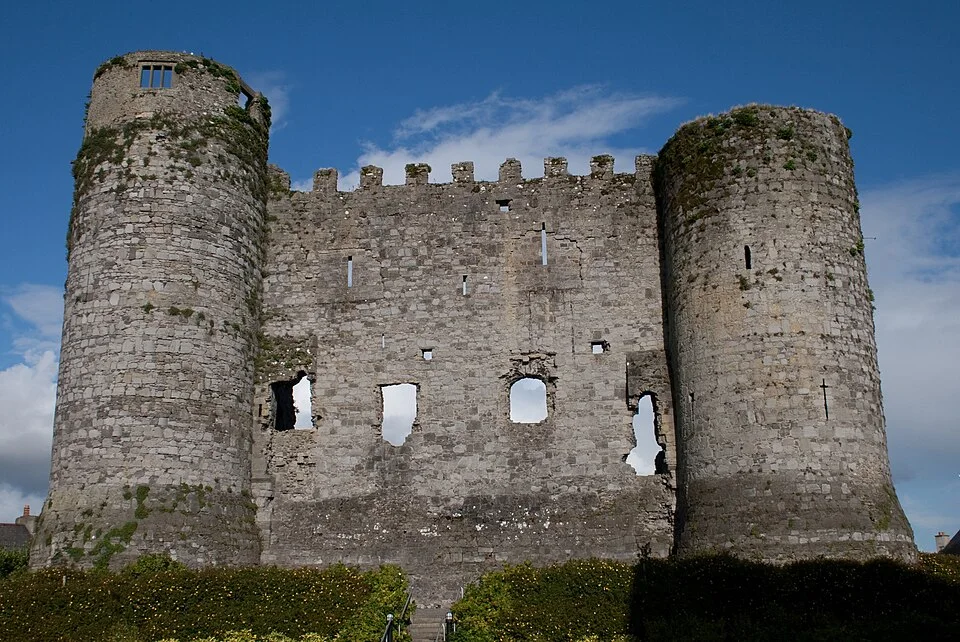
Photo: Andreas F. Borchert · CC BY-SA 4.0. Resized and converted for the web. Full credit.

Carlow Castle is a fragment of a much larger stronghold, with a particularly dramatic reason for its present shape. The surviving towers and wall stand near the meeting of the Barrow and Burren. A short visit becomes more interesting when the missing building is considered alongside what remains.
Look for the four-towered plan
The early-thirteenth-century stone castle is attributed to William Marshal and belonged to a group of rectangular keeps with round corner towers. The surviving side hints at that larger form. Compare the remains with the official description rather than assuming today’s outline was the original design.
Remember its administrative role
The castle was more than a military position. It also served residential and administrative purposes, with later alterations associated with the Irish Exchequer. That changing use helps explain why castles were repeatedly adapted rather than preserved as single-period buildings.
Understand the nineteenth-century damage
In 1814 an attempt to enlarge space for an asylum used explosive charges at the base. The damage explains much of the ruined appearance. It is a more specific story than attributing every missing wall to a medieval siege or to Cromwell.
Before you go
Heritage Ireland identifies Carlow Castle as an unguided state monument. Use current public access and remain clear of barriers, masonry and any areas closed for conservation. Do not climb the towers or look for an interior tour that is not offered. Wear suitable footwear and plan the stop with another town attraction, leaving time to cross roads safely around Castle Hill.
Plan your visit
Heritage Ireland: Carlow Castle · Carlow Heritage: castle history
More in Carlow
Carlow County Museum: let a few objects open up the county · Explore the county guide
Have a story to share?
Tell us about a place, a journey or a different side of Ireland. Send your article to the Ramble editorial team for review.