
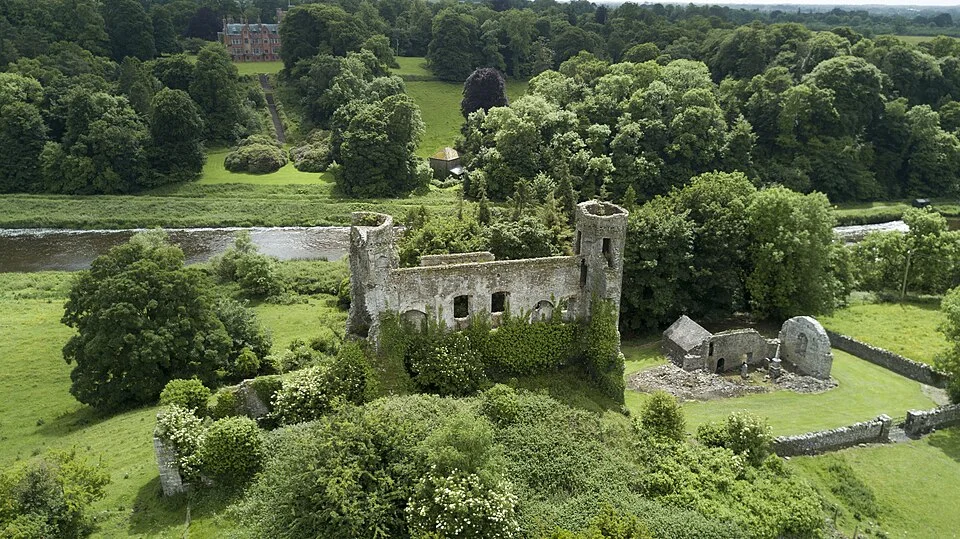
Castle and valley context; confirm the recognised access before visiting. Photo: Koosdejong · CC BY-SA 4.0. Resized and converted for the web. Full credit.

Dunmoe Castle is a substantial ruin overlooking the Boyne, but not a furnished house or a guided castle experience. Two sides survive from a once much larger building. Its value as a visit lies in understanding the remaining structure and the position it occupied, with the care an unguided site requires.
Look at scale before detail
Stand back where access permits and consider the height of the surviving walls. A fragment can communicate the scale of the former building more clearly than a reconstructed room. The river setting also explains why the castle is more than an isolated piece of masonry in a field.
Keep the dating cautious
The OPW describes a castle built in a thirteenth-century style but probably constructed in the fifteenth century. That distinction is useful: architectural appearance does not always supply a straightforward construction date. It is a better starting point than attaching the oldest possible century to the whole ruin.
Allow for change and damage
The Darcy family’s castle endured periods of conflict before a destructive fire in 1798. What survives is the result of that long history rather than a building frozen at one moment. Look for evidence of former floors and openings from a safe position without attempting to reach them.
Before you go
Check the recognised access before travelling and respect gates, farming activity and any local restriction. State ownership of a monument does not make every neighbouring field or track a public route. Do not enter unstable areas or climb walls. Wear suitable footwear and choose daylight. If access is unclear on arrival, leave the visit for another time rather than improvising a route through private ground. A quiet observation of the exterior is the appropriate ambition here.
Plan your visit
More in Meath
Girley Bog: a short route through a landscape that needs care · Explore the county guide
Have a story to share?
Tell us about a place, a journey or a different side of Ireland. Send your article to the Ramble editorial team for review.